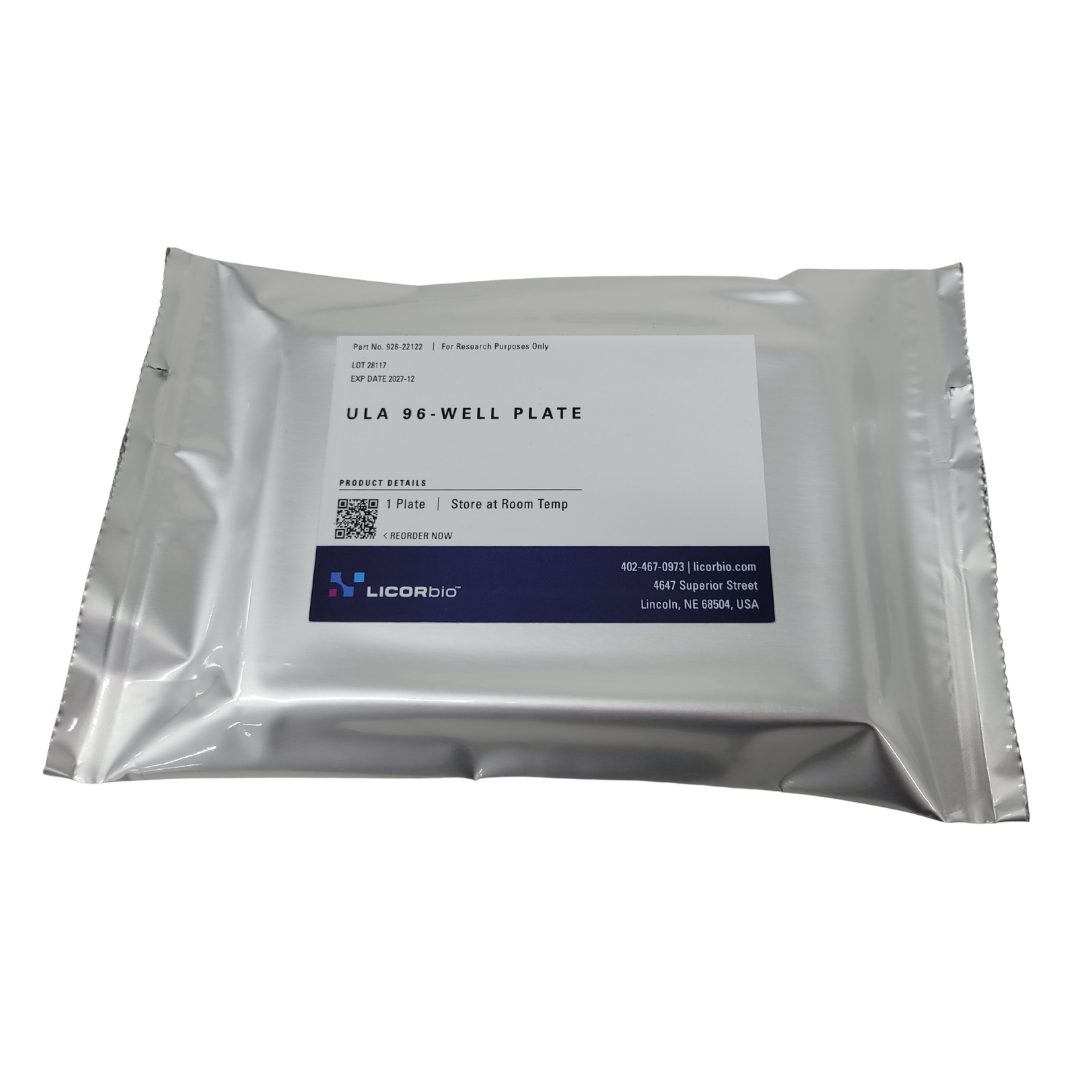
Clear, round-bottom 96-well polystyrene plates with a proprietary cell-repelling coating for uniform spheroid and/or organoid formation. Obtain reliable spheroid formation across all wells and batches with a wide range of cell types, including primary, tumor, and stem cells.
Research use only. Not intended for diagnostic or therapeutic use.
Specifications
Pack of 4 individually wrapped ULA 96 well plates.
licorbio has validated these plates using the cell lines PANC-1, BxPC-3, Hep G2, T-47D, BT-474, and LNCaP. You may use your preferred cell line; however, please be aware that some cell lines do not readily form well-defined or uniform spheroids and may require additional additives (e.g. ECM and growth hormones) to form tight spheroids.
Storage
Store at RT. Protect from the light.
Frequent Asked Questions (FAQ)
1. Can spheroids/organoids be generated from any cell type?
licorbio’s ULA plate is compatible with a wide variety of human and animal derived cell lines or primary cells. The plate’s surface is engineered to be highly non-adhesive, enabling normally adherent cells to interact primarily with each other rather than attach to the plate surface. This creates an ultra-low attachment environment that supports spheroid formation in a broad variety of cells.
In general, cells that readily attach and grow in culture tend to have a higher likelihood of forming spheroids. However, not all cell types naturally form spheroids. Their ability to aggregate depends on factors such as the original tissue’s structure, function, and morphology, as well as how the cells were isolated.
To optimize spheroid formation, experimental conditions may need adjustment. This can include changing cell seeding density, modifying media composition, or adding supportive components such as extracellular matrix (ECM) supplements or matrix-producing cells. When working with a new cell type, it is best to test a range of conditions to determine the most effective approach.
2. What is the maximum volume that the wells can hold?
licorbio’s ULA 96-well plate can hold up to 300 μL maximum volume, but a working volume between 75 μL to 250 μL is typically sufficient for seeding and growing spheroid cultures.
3. What are the benefits of using round-bottom vs flat-bottom ULA microplates for spheroid/organoid formation?
Round-bottom microplates with ULA coatings, such as licorbio’s ULA plate, are designed to consistently produce a single, uniform spheroid in each well. The curved well shape helps guide cells toward the center, promoting even aggregation.
In contrast, flat-bottom ULA wells often lead to the formation of multiple irregular cell clusters. These clusters can vary in size and distribution within a well, resulting in greater variability between wells. Due to this inconsistency, flat-bottom formats are generally less suitable for applications that require reproducibility or high-throughput screening.
4. What are the recommended storage conditions for licorbio’s ULA plate?
licorbio’s ULA microplates are highly stable and can be stored at room temperature in a dry environment and protected from light. The plates are stable from -20 °C to +50 °C.
5. Which cell lines have been validated to form spheroids in licorbio’s ULA microplate?
So far, the following cell lines have been used in-house and observed to form spherical cultures: PANC-1, BxPC-3, Hep G2, T-47D, BT-474, and LNCaP. MDA-MB-231 and SW480 were also grown in these plates with the addition of ECM.
6. What specifications do I need to know in order to use licorbio’s Atlas™ Imaging Systems?
For imaging using the licorbio’s Atlas Imager, the following specifications should be entered into the Acquire ribbon in the Image Studio Software:
Under Focus > Select Focus choose:
3.1 mm focus off set with focus refinement off
2.0 mm air gap
Note: depending on your spheroid size, you may have to adjust the focus in 0.1 mm increments.
6. What is the chemical compatibility?
The plate’s coating is not resistant against organic solvents such as high concentrations (>1% (v/v)) of DMSO. The coating itself doesn’t contain any functional groups that could react with other chemicals.
7. What sterilization method is used for packaging?
These plates are sterilized by electron beam irradiation according to DIN EN ISO 11137 and individually sealed in foil-packaging.
8. How do licorbio ULA plates compare with competing products?
We tested our plates against four competitor plates, and as shown in the image below, licorbio consistently outperformed the competitors in producing uniform, compact spheroids. Across all four cell lines, licorbio plates produced tighter, more uniform spheroids at 24 hours compared to the other four brands tested, with less satellite clustering and more consistent well-to-well morphology.
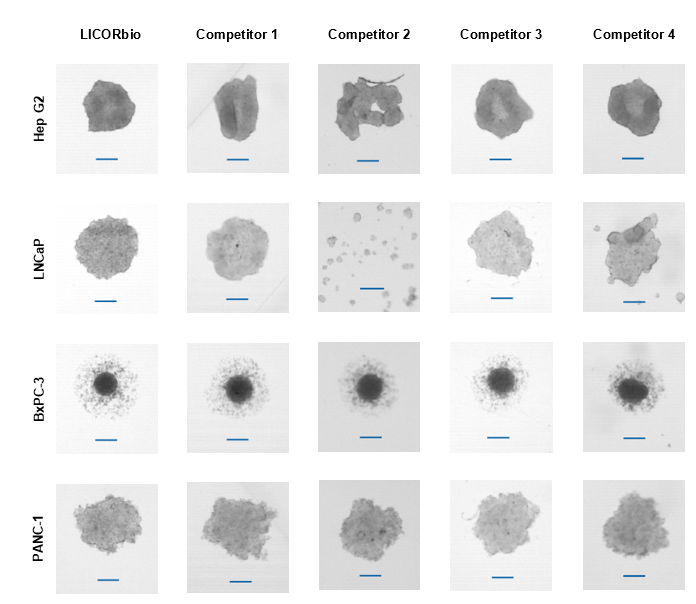
Image 1: PANC-1, BxPC-3, LNCaP, and Hep G2 cells were seeded at the same density in five different ULA plate brands. Images were acquired 24 hours after seeding using the licorbio Atlas Imager 630 trans channel at 5 µm resolution.